Tradition in Transition: What's Next?
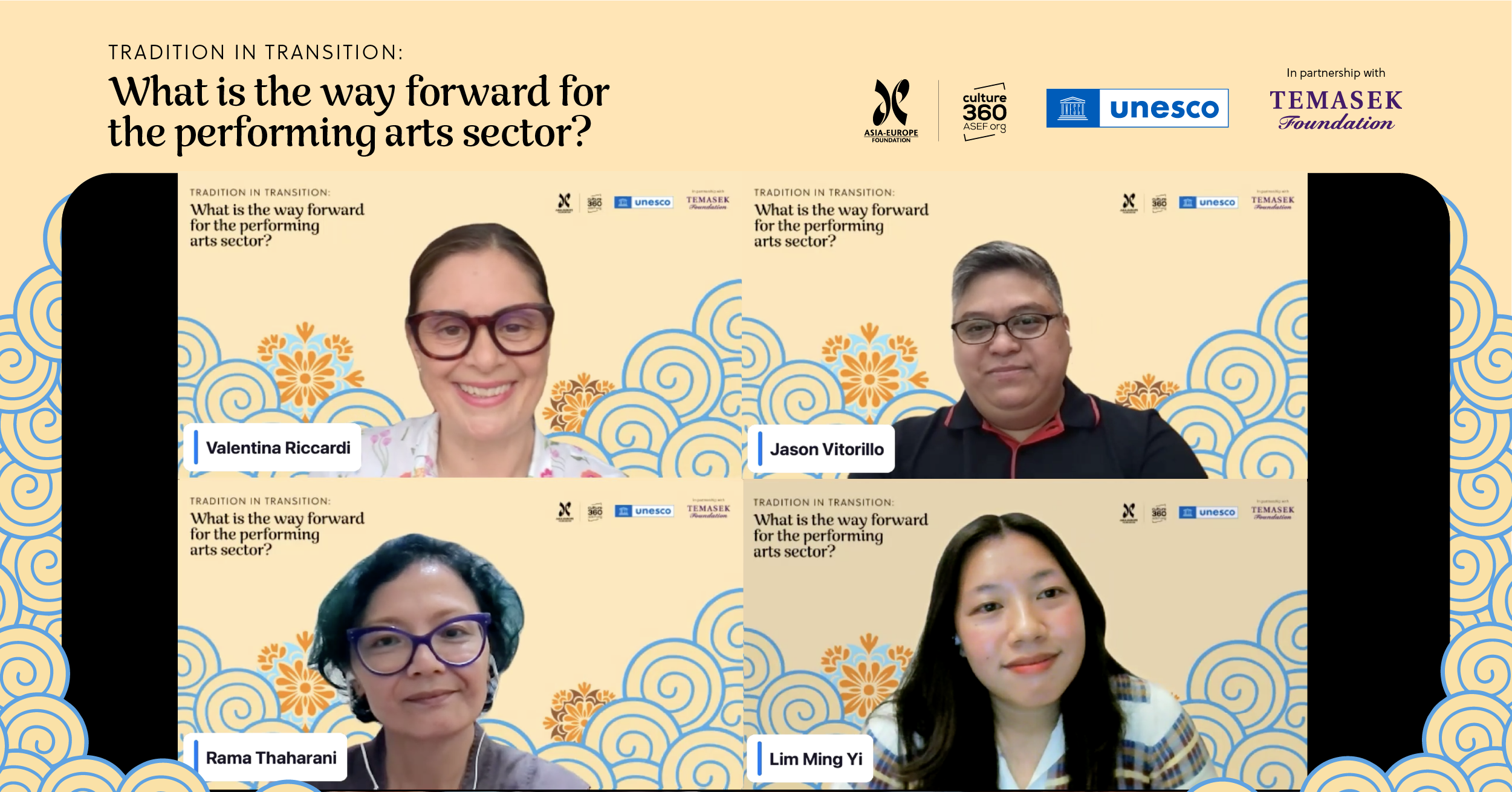
Read this interview with the speakers of 'Tradition in Transition: What is the way forward for the performing arts sector?’, a collaboration between ASEF culture360 and UNESCO Jakarta on 8 April 2026. As an outcome of the webinar, ASEF culture360 answers some questions asked by the online attendees – on representing and leveraging the artform, its diversity and what is needed next?
The responses from the interviewees have been edited for length and clarity.
- A balancing act
How can the sector balance artistic integrity with commercial viability?
Rama Thaharani: Instead of framing artistic integrity and commercial viability as something that needs to be ‘balanced’, the focus should shift towards the conditions and infrastructure that shape how a work can exist and circulate. For instance, what kind of support systems, partnerships, and platforms are available for artists to develop and sustain their work?
Producing then plays a key role in moulding these conditions, and shaping how different kinds of practices and works (including those that may not be immediately ‘marketable’), can still remain visible, supported, and meaningful across different contexts.
Lim Ming Yi: Balancing artistic integrity with commercial viability requires a reflexive approach rather than a fixed formula. It is important for artists and organisations to first establish clear, non-negotiable boundaries that pertain to the core aesthetics of the artform, its philosophical underpinnings, or ethical considerations in representation and practice. Once these foundations are firmly established, a spectrum of elements remain that can be adapted, negotiated, or reinterpreted in response to contemporary contexts and audience engagement.
For instance, within Siong Leng’s practice, contemporary productions act as accessible entry points to Nanyin, a musical artform that originated in China. Through adopting innovative or interdisciplinary formats, these works spark curiosity and lead to sustained audience engagement, including learning and participation.
Artistic integrity endures not through rigid preservation, but through informed adaptation that keeps traditions strongly rooted in culture while giving room to evolve.
2. Building bridges across practices and cultures
What are some of the strategies to bridge gaps/differences between different practices and cultures, especially in intercultural works/projects?
Rama Thaharani: In our experience at Kelola Foundation, bridging differences across practices and cultures is less about creating alignment, and more about making space for different ways of working, different temporalities, and expectations of what a process or an outcome should be.
It requires acknowledging that translation is not neutral. It involves making choices: what is made visible, what remains less visible, and who gets to decide? In this process, respect and empathetic listening are essential.
One important strategy therefore, is to work with longer-term, process-based engagements rather than short-term project outputs. This creates conditions for trust to develop, but also for open communication, negotiation, and reflection, to take place in a meaningful way.
Lim Ming Yi: Effective intercultural collaboration relies on research, dialogue, and mutual respect. It is essential to invest time in understanding the historical, cultural, and aesthetic frameworks of the respective artforms involved, alongside active listening and conversations that surface implicit knowledge, values, and sensitivities embedded within each tradition.
Following which, a mutual understanding is best developed through exploratory processes such as workshops, improvisational sessions, or “jamming”, where artists can identify points of resonance, negotiate differences and gradually built a shared vocabulary. Importantly, such interactions should be iterative and dialogic. Where possible, co-creation should be emphasised. This involves all parties having agency in shaping the artistic direction, ensuring that the outcome is not dominated by one form over another but instead is a genuine reflection of both.
Successful intercultural work is not merely about blending forms, but about cultivating an environment of trust and reciprocity.
When approached with sincerity and patience, the creative process becomes organic, allowing the resulting work to resonate authentically across cultural boundaries, not just with the artists but with the audiences.
3. Looking ahead: what comes next?
If you could implement one policy or initiative today, what would it be and why?
Rama Thaharani: It would be the development of long-term, process-based support structures. This could take the form of incubation, mentorship programmes, and sustained partnerships for artistic development.
Presently, many existing systems are still oriented towards short-term outputs – completed works, measurable results, or immediate visibility. While important, they often do not reflect how artistic practices actually develop over time. By investing in longer timelines and shared platforms, it encourages deeper forms of inquiry, risk-taking, experimentation, and stronger connections across the ecosystem.
Ultimately, if we understand heritage and artistic practice as something that is lived, then what needs to be supported are not only the works themselves, but the conditions in which they can continue to evolve.
Lim Ming Yi: Echoing what Rama has mentioned, I would advocate for rethinking how we structure the support for the arts. Do we create conditions for continuity, depth, and risk-taking, or do we continue to encourage what is immediately visible, measurable, and producible?
The current funding structure in Singapore while substantial, remains largely structured around projects, outputs, and measurable outcomes. Even where longer-term or process-based support exists, it is often limited in scope or accessibility. As a result, many artists continue to operate within short cycles of production, and deeper forms of artistic development, such as research, transmission, and experimentation, are harder to sustain.
The strength of an arts ecosystem is not measured by output alone, but whether that output contributes to sustained artistic development, continuity of practice, and long-term cultural capacity.
About the Speakers
Rama Thaharani is a performing arts producer, working across field and capacity strengthening. She currently serves as the Director at Kelola Foundation, an independent non-profit organisation dedicated to supporting the growth and sustainability of Indonesia's performing arts sector.
Lim Ming Yi is an artist and outreach manager at Siong Leng Musical Association. Specialising in Nanyin pipa, sanxian, and vocals, Ming Yi has performed internationally with the company, presenting Nanyin to global audiences and contributing to the artform’s cross-cultural reach.
Watch the recording of ‘Tradition in Transition: What is the way forward for the performing arts sector?’ here: